



If you are comparing care providers for someone you love, CQC ratings still matter — but many families are unsure what has changed and what questions to ask. This guide breaks down the current CQC approach in a way that is practical, calm and genuinely useful.

What the CQC Actually Does — and What It Doesn't
If you are comparing care providers for someone you love, CQC ratings still matter — but many families are unsure what has changed and what questions to ask. This guide breaks down the current CQC approach in a way that is practical, calm and genuinely useful.
The Care Quality Commission is the independent regulator for health and social care in England. For families in Chesterfield, Bolsover, Worksop, Mansfield and across North East Derbyshire, it is the most widely recognised way of checking whether a care provider is safe and well run. But it is worth understanding what the CQC can and cannot tell you.
A CQC rating reflects what inspectors found on the day they visited, set against a framework of quality standards. It does not tell you whether the carers are kind, whether your relative will feel comfortable with them, or whether the office staff return calls promptly. Those things matter enormously — and they are things you will need to find out yourself. The rating is a starting point, not the whole picture.
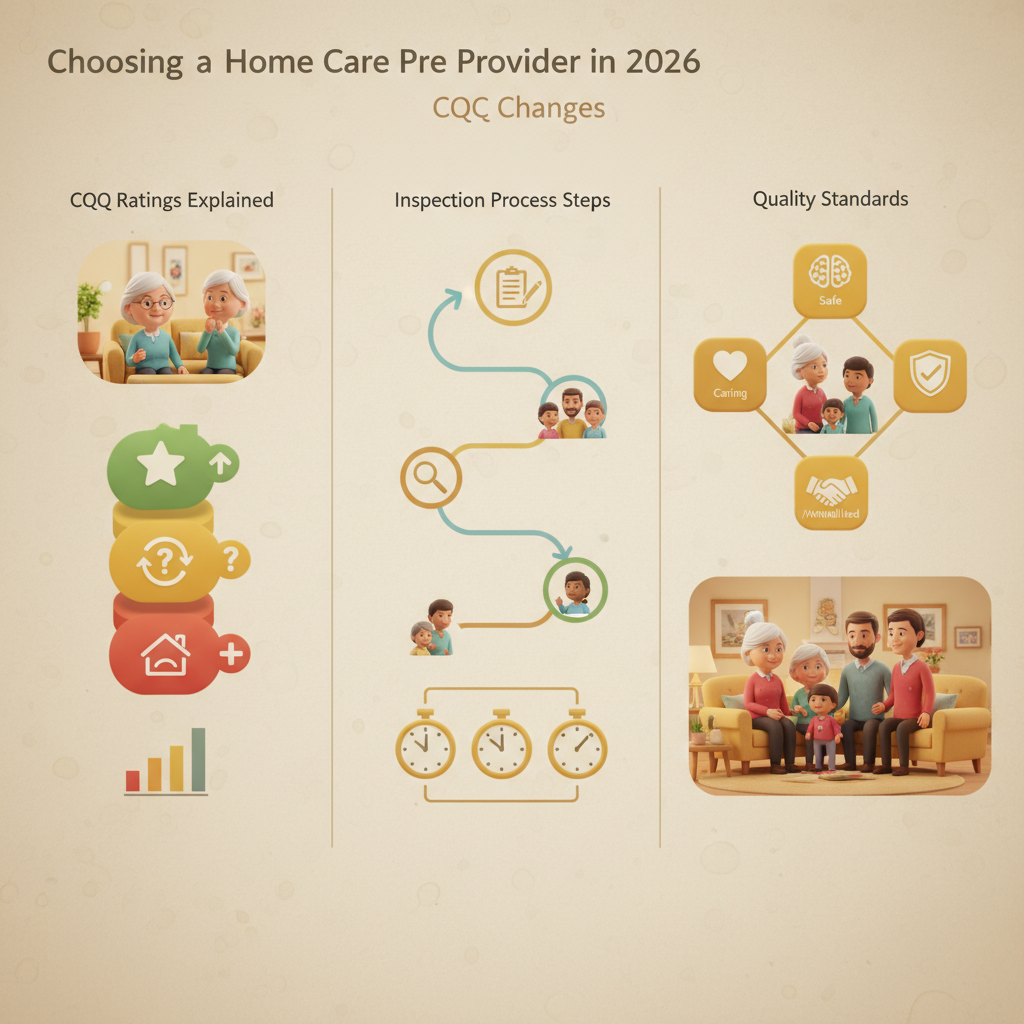
Providers are rated across five areas: Safe, Effective, Caring, Responsive, and Well-led. Each receives a score of Outstanding, Good, Requires Improvement, or Inadequate. Families often focus on the overall rating, but reading through the individual section scores and the inspection report itself can be far more informative.

What Has Changed with the CQC in 2026
The CQC has been through a significant period of change over the past couple of years. In 2023 and 2024, it introduced a new Single Assessment Framework, which replaced the previous approach built around detailed Key Lines of Enquiry. The new framework uses Quality Statements — short descriptions of what good care looks like — and gathers evidence from a wider range of sources, including feedback from people who use services, families, and staff.
This shift was intended to make inspections more dynamic and less reliant on a single visit. In theory, it allows the CQC to build up a picture of a service over time rather than relying on one snapshot. In practice, many providers found the transition complicated, and the CQC itself acknowledged delays and inconsistencies during the roll-out period.
By 2026, the new framework is more established, but families should be aware of a few things. Some providers may have older ratings that have not been updated under the new system. A rating from 2022 or early 2023 may not reflect current standards or the current management team. It is always worth checking the date of the last inspection on the CQC website, not just the headline rating.
There have also been changes to how the CQC uses evidence between inspections. If concerns are raised — whether by staff, families, or partner organisations — the CQC can act on these without waiting for a scheduled visit. This means that a provider's current situation may differ from what an older report describes, in either direction.
What to Look For Beyond the Rating
A Good or Outstanding rating from the CQC is genuinely encouraging. It means inspectors found the service to be meeting or exceeding the standards expected. But families choosing domiciliary care — where carers visit someone at home rather than moving them into a residential setting — often find that the day-to-day experience depends on factors that an inspection report cannot fully capture.
Consistency of carers matters enormously. Ask any provider you are considering how they ensure the same small group of carers visits regularly, rather than a different face each time. For older people, and especially for those living with dementia, familiar faces are not a luxury — they are part of safe, dignified care.
Communication is another area worth probing. How does the provider keep families informed? Is there an app or digital care record that relatives can access? What happens if a carer is running late or cannot attend? Good providers have clear, reliable answers to these questions. Vague reassurances are a yellow flag.
Staff retention and training tell you a great deal. High turnover often signals poor management or conditions that drive carers away — and that instability filters directly into the quality of care your relative receives. Ask how long the average carer has worked for the provider, and what ongoing training looks like beyond the statutory minimum.
Questions Worth Asking Before You Commit
When you speak to or visit a potential provider, these are the questions that tend to be most revealing:
How do you match carers to clients? Good providers think carefully about compatibility — shared interests, communication style, language, and personality — not just geography and availability.
What happens if my relative's needs change? Domiciliary care should flex as circumstances evolve. Ask specifically about the process for increasing hours, adding specialist support such as live-in care, or transitioning to a different type of provision if needed.
How do you handle concerns or complaints? Every provider will tell you they have an open-door policy. Ask for specifics — who do you speak to, what is the response time, and can you see an example of how a concern was resolved? A confident, transparent answer is a good sign.
Can I speak to a current or former family? Reputable providers are usually happy to arrange this. If the response is evasive, that is worth noting.
What Good Domiciliary Care Looks Like in Practice
Good home care is not complicated to describe, even if it takes real effort to deliver consistently. It means carers arriving on time, staying for the agreed duration, and giving their full attention to the person they are visiting — not rushing through tasks with one eye on the next call. It means listening, noticing when something seems off, and communicating what they have observed back to the office and to the family.
It means management that knows their carers by name, supports them properly, and responds quickly when something needs addressing. It means care plans that are genuinely individual — not generic documents that could apply to anyone — and that are reviewed regularly as the person's needs and preferences change.
For families in North East Derbyshire, the geography of domiciliary care adds its own layer of complexity. Rural areas around Bolsover and the Derbyshire countryside can mean longer travel times between calls, which affects how reliably carers can keep to scheduled visit times. It is worth asking how a provider manages rural rounds and what buffer they build in for travel.
Finding the Right Care in Your Area
If you are looking for domiciliary care in Chesterfield, Clay Cross, Eckington, Dronfield, Worksop, Mansfield or the surrounding villages, the process of comparing providers can feel daunting — particularly if you are doing it at a moment of pressure, when a hospital discharge is looming or a situation at home has changed quickly.
Take your time where you can. Ask for a no-obligation home visit from any provider you are seriously considering. See who turns up, how they listen, and whether they seem genuinely interested in the person who will be receiving care — not just in completing an assessment form.
Use the CQC website to read the most recent inspection report in full, not just the summary rating. Pay particular attention to the Caring and Well-led sections, and note the date of the inspection. If a report is more than two years old, ask the provider what has changed since then.
And trust your instincts. Families who have been through this process often say that the most important thing they noticed was how a provider made them feel — whether they felt heard, respected, and confident that their relative would be treated with dignity. That impression, formed in the first conversation or visit, tends to be reliable.
If you would like to talk through what care might look like for someone in your family — without any pressure or obligation — The Right Home Care Team is here to help. We are based in North East Derbyshire and know the local area well. You are welcome to call us or use the contact form on this website, and we will do our best to give you honest, useful information whatever you decide.


